
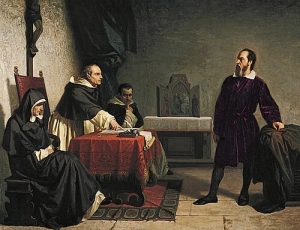
Cristiano Banti's 1857 painting of Galileo facing the Roman Inquisition
Introduction
The Example of Galileo
Probably the most famous example of taking a Bible passage too literally from a scientific perspective is the example of Galileo in the 1600s. The prevailing view of the time was that earth was the center of the universe, known as geo-centrism. This was justified by passages such as Psalm 93:1 (KJV) (emphasis added).
The Lord reigneth, he is clothed with majesty; the Lord is clothed with strength, wherewith he hath girded himself: the world also is stablished, that it cannot be moved.
or 1 Sam 2:8 (KJV) (emphasis added).
He raiseth up the poor out of the dust, and lifteth up the beggar from the dunghill, to set them among princes, and to make them inherit the throne of glory: for the pillars of the earth are the Lord’s, and he hath set the world upon them.
Other passages that were used include 1 Chron. 16:30, Psalm 8:29, Psalm 96:10, Psalm 104:5, Psalm 119:90, and Isaiah 48:13.
Then Galileo made his observations of the earth’s moon and some of the planets through his telescope and could only consistently interpret what he found using a helio-centric model, with the planets revolving around the sun. These conclusions from Galileo were not accepted by the Catholic church and he was put under house arrest in 1633. There are still some who believe in a helio-centric model based on Scripture. But for the majority of Christians this is an example of where Biblical passages were taken too literally. In fact, the Catholic church did formally acknowledge its error and pardoned Galileo on October 31, 1992.
This site contends that the Bible also may be using metaphor, from a scientific perspective, when it uses the phrase, “and there was evening and there was morning, the first day” (or second day, etc.) in Genesis 1. This can be seen as a metaphor for a time of ending and beginning – a new phase of changes in the earth.