

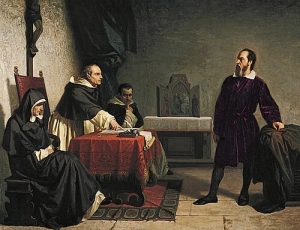
Cristiano Banti's 1857 painting of Galileo facing the Roman Inquisition
Introduction
The Bible uses metaphor in many places. Sometimes it is difficult to discern which parts of a passage are to be taken as metaphor and which parts are to be taken literally. Making that distinction is important. Many false teachings (e.g. Gnosticism) have been propagated based on the misunderstanding of literal facts being taken metaphorically. However, there are also instances of mistakes from taking passages in the Bible as literal when they were meant to be taken as metaphorical. There are some examples below that are related to science.
The Example of Galileo
The Lord reigneth, he is clothed with majesty; the Lord is clothed with strength, wherewith he hath girded himself: the world also is stablished, that it cannot be moved.or 1 Sam 2:8 (KJV) (emphasis added).
He raiseth up the poor out of the dust, and lifteth up the beggar from the dunghill, to set them among princes, and to make them inherit the throne of glory: for the pillars of the earth are the Lord’s, and he hath set the world upon them.Other passages that were used include 1 Chron. 16:30, Psalm 8:29, Psalm 96:10, Psalm 104:5, Psalm 119:90, and Isaiah 48:13. Then Galileo made his observations of the earth’s moon and some of the planets through his telescope. Galileo could only consistently interpret what he found using a helio-centric model, meaning that the planets revolved around the sun. These conclusions from Galileo were not accepted by the Catholic church because of the geocentric view they had based on the Biblical passages mentioned above. So, Galileo was put under house arrest in 1633. There are still some who believe in a geocentric model based on Scripture. But for the majority of Christians this is an example of where Biblical passages were taken too literally. In fact, the Catholic church did formally acknowledge its error and pardoned Galileo on October 31, 1992.
The Vault in the Sky
A lesser known example to us living today is the controversy about the vault or firmament that is mentioned in Genesis 1:6 (KJV) (emphasis added).
And God said, Let there be a firmament in the midst of the waters, and let it divide the waters from the waters.
Instead of “firmament”, other versions use “dome” (Common English Bible and Contemporary English Version), “vaulted dome” (Lexham English Bible), “expanse” (English Standard Version and Modern English Version), “space” (New Living Translation), “open space” (New Life Version), or “canopy” (International Standard Version). The variations in translations probably reflect some of the historical ambivalence about the exact meaning of this passage.

Strict Literalists
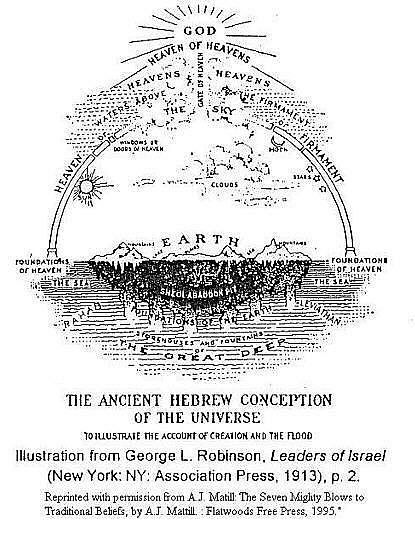
The original Hebrew verb raqa means to "to beat out or hammer thin," as a blacksmith hammers a piece of bronze into a solid metal bowl or plate (see Exodus 39:3). The ancient Near Eastern cultures (Babylonians, Egyptians) visualized the cosmos as a three-tiered system: a flat Earth supported by pillars below, surrounded by a subterranean ocean, and covered by a rigid, solid dome holding back a vast celestial ocean ("the waters above"). Windows or sluice gates in this dome opened to let down rain. Many scholars have assumed that Moses used the same picture when he wrote the Genesis 1:6 passage.
In the early Church and Middle Ages, several theologians argued that Christians were obligated to accept a solid overhead structure holding up liquid water, because taking scripture literally meant taking its physical descriptions literally. They pointed to Job 37:18 ("Can you join him in spreading out the skies, hard as a mirror of cast bronze?") and Psalm 148:4 ("Praise him... you waters above the skies!"). Cosmas Indicopleustes, a 6th-century Christian monk and geographer, even wrote a massive work called Christian Topography. He argued that the entire universe was shaped like the Jewish Tabernacle - a rectangular box with a vaulted roof. Cosmas furiously attacked Greek astronomers who claimed the Earth was a sphere surrounded by empty space, accusing them of pagan heresy for denying a physical sky-roof. The primary fear was a "domino effect" - if the raqiya wasn't a real physical barrier holding back actual water, then Moses was mistaken, and biblical authority would crumble.
The Natural Philosophers & Reconcilers
As Greek astronomical knowledge spread through the Roman world and into the Middle Ages, Christian scholars realized that physical observation completely contradicted a solid dome.
- Physical Objections: Air pressure, clouds, the water cycle (evaporation), and planetary orbits made it clear there was no physical bronze dish or upper water ocean orbiting above us.
- St. Augustine’s Caveat (4th Century): Augustine warned Christians against taking physical descriptions in the Bible too literally when established natural observations said otherwise. On the firmament, he argued that “waters above” might refer to vapor/clouds or that the word firmament meant “firm/stable” in a spiritual or structural sense, not a metallic one.
- Calvin’s Accommodation (16th Century): John Calvin argued that “waters above the firmament” simply referred to rain clouds. He asserted that when Moses wrote about the sky, he was using poetic hyperbole to describe the expansive atmosphere where clouds hang.
- Modern Historical Criticism: By the 19th and 20th centuries, scholars generally agreed that the author of Genesis did share the ancient Near Eastern belief in a solid sky dome, but that God was inspiring the theological message (that God created order out of chaos) rather than delivering an accurate physical blueprint of the universe.
We would suggest that the author of Genesis did not fully understand what he was writing from a modern scientific standpoint. That would not be reasonable since Genesis was written long before modern science. However, we believe that through the inspiration of God’s Spirit, the author of Genesis wrote in a way that can now be shown to be scientifically accurate when we make certain reasonable assumptions.
Metaphor May Be Used with Morning and Evening As Well
This site contends that the Bible also may be using metaphor, from a scientific perspective, when it uses the phrase, “and there was evening and there was morning, the first day” (or second day, etc.) in Genesis 1. This use of evening and morning can be seen as a metaphor for a time of ending and beginning. Each time that this phrase of “evening” and then “morning” was used, there was a different phase or set of significant changes that took place on the earth.

