

In the beginning God created the heavens and the earth.
Point of View:
Third Person
Omniscient
Day:
Pre-Day 1
Genesis Event 1
The Big Bang
Get Your Reminder of the Harmony Between Science and Genesis 1 from the Big Bible Store!
Just click on the image and you will be directed to the Big Bible Store for more information.

Scientific Description of the Event
The Big Bang is the name commonly used for the scientific description of the beginning of our physical universe. The core principles of the Big Bang come from the General Theory of Relativity from Albert Einstein. Beginning in the 1920s, more and more evidence accumulated to justify the somewhat surprising and at times unfathomable conclusions from Einstein’s theory.
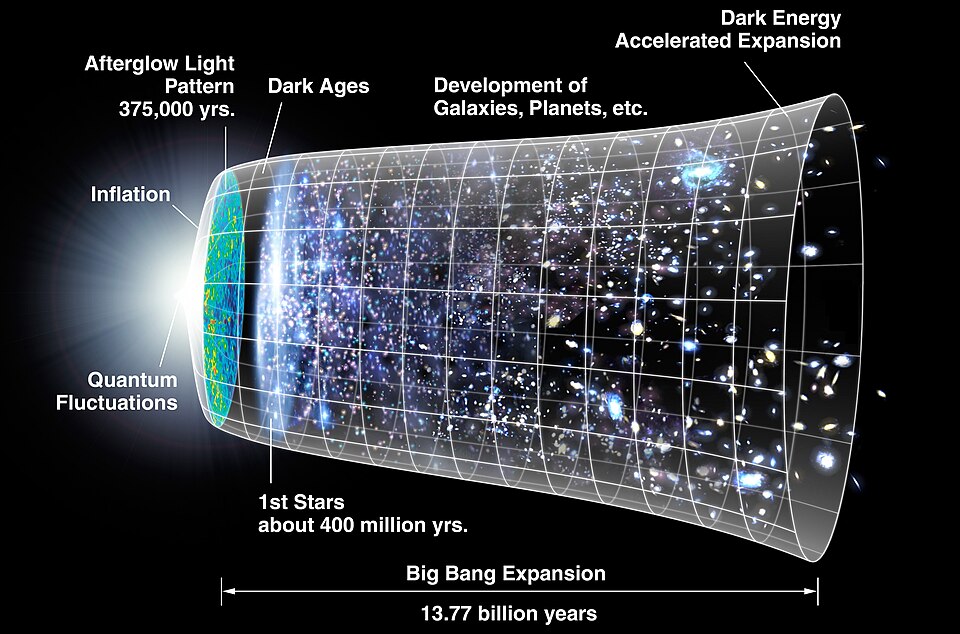
Certainly one of the most unfathomable consequences of the Big Bang theory is that all of the energy and matter of the entire universe began in a very small and extremely hot state about 13.8 billion years ago. And then from that state everything that we see in our universe has been constructed, including all of the galaxies, stars, planets and everything that has ever lived or died on planet Earth. Scientists also have confidence that they understand many of the events that happened during the 13.8 billion years since that cosmic Big Bang. Scientists feel confident in tracing events back to about 1 microsecond after the Big Bang. The 1 microsecond marker after the Big Bang has been given the name of “hot Big Bang” as a point of reference for other events.
As the hot Big Bang began, the universe expanded very rapidly. As it expanded, energy turned into tiny particles such as quarks and electrons. Quarks later joined together to form protons and neutrons. Within the first few minutes, the universe cooled enough for protons and neutrons to form the nuclei of the simplest elements. Most of the formed nuclei were for hydrogen and helium, with tiny amounts of lithium. However, the universe was still too hot for full atoms to exist. Electrons were moving too fast to attach themselves to nuclei. For about 380,000 years, the universe was filled with this hot, glowing fog of charged particles. Electromagnetic waves were present at that time but could not travel freely because they kept bumping into electrons. As the universe cooled, atoms formed, and then electromagnetic waves could travel freely through space. Those ancient electromagnetic waves are called the Cosmic Microwave Background.
The universe then entered a long period where there were no stars. Then about 100 to 200 million years after the Big Bang, the first stars were born. These early stars created heavier elements such as carbon and oxygen for the first time. When some of these stars exploded as supernovae, these explosions scattered the newly formed elements into space. Over billions of years, galaxies like our Milky Way developed. Then about 4.6 billion years ago, in a spiral arm of the Milky Way galaxy, our Sun developed. Around the young Sun, leftover gas and dust flattened into a spinning disk called a protoplanetary disk. Over time, rocky planets began forming around the Sun from the protoplanetary disk. These included Mercury, Venus, Earth, and Mars. In the colder outer regions, gas giants such as Jupiter and Saturn formed.
This long chain of events – from the expansion of space to the formation of simple elements, to the birth and death of stars, to the creation of galaxies, and finally to the collapse of a gas cloud forming the Sun and Earth – shows how the universe slowly became more complex. Each stage built on the one before it. Without the Big Bang producing hydrogen and helium, there would be no stars. Without stars making heavy elements, there would be no rocky planets. And without those rocky planets, we would not have the Earth as we know it.
Scientific Evidence for this Event
Scientific evidence for the Big Bang is very strong. The Big Bang theory is the most widely accepted theory for explaining large scale events in our cosmos. This theory is supported by the following sources of evidence.
- The General Theory of Relativity was developed by Albert Einstein in 1915 and provides the theoretical foundation for the Big Bang Theory. This theory provides a different approach to explaining gravity which is consistent with the Newtonian theory of gravity that had been used for several centuries before it. But the General Theory of Relativity has many other predictions that have been confirmed by discoveries since then.
- A 1919 expedition that measured the bending of light during a solar eclipse was the first confirmation of the General Theory of Relativity.
- The prediction of a cosmic beginning by the Belgian priest Georges Lemaître was based on the General Theory of Relativity. His initial paper in 1927 predicted an expanding universe and a 1931 paper predicted a cosmic beginning.
- Observations of an expanding universe, as first discovered by Edwin Hubble in 1929, is consistent with the General Theory of Relativity and a cosmic beginning.
- Discovery of the Cosmic Microwave Background (CMB) in 1965 is another confirmation for the General Theory of Relativity.
- The amounts of the elements in the universe, especially the simplest elements of hydrogen and helium, agree with the predictions of what should have been formed during the earliest stages of the universe.
How the Scientific Event Description Harmonizes with Genesis 1
To begin with, it is helpful to understand what the phrase “the heavens and the earth” would have meant in ancient Hebrew. Ancient Hebrew did not have a word that can be translated as “universe” since that concept had not been developed when Genesis was written. But the phrase “the heavens and the earth” is as close to the meaning of “universe” as possible for that time in history. In ancient Hebrew, “the heavens and the earth” is called a “merism”. A merism is a figure of speech that uses two or more elements to imply everything in between, such as using “high and low” to mean “everywhere”. A merism is often used to convey the idea of a totality. In the case of Genesis 1:1, the phrase “the heavens and the earth” means all that exists in the physical realm. This is today what we would call our universe.
So, when we put Genesis 1:1 in today’s language, it is clearly saying that in the beginning God created our universe. Science cannot say who or what created the universe. But science does tell us that during the Big Bang event, all that exists in the physical realm of our universe did appear as one superhot entity. So, this is one way in which Genesis 1:1 is in strong harmony with the Big Bang. Both of them are consistent with the understanding that there was indeed one cosmic event where the entire physical universe came into being.

Scientific Timeline of the Event
From a scientific standpoint, the Big Bang is the first event in our universe. The “hot Big Bang” at about 1 microsecond after the Big Bang is a point of reference for other subsequent events. Concerning what happened before that 1 microsecond time marker there are various scientific theories with varying degrees of support. But at the time t=0 – the very beginning of the universe – science cannot confidently say what caused the Big Bang. Therefore, from a scientific perspective it is as acceptable to say that there was a supernatural cause to the universe as it is to say that there was no supernatural cause to the universe. Many scientists try to find a cause for the universe purely from mathematical and scientific laws. But none of these approaches have yet produced models that scientists can be confident of.

How the Event Timeline Harmonizes with Genesis 1
The harmony between Genesis 1 and the Big Bang is very strong and beautiful.
Genesis 1:1 is the first statement of the entire Bible. As discussed above, the language of Genesis 1:1 is consistent with the creation of the entire physical universe. Since this is the first statement of Genesis 1, then it is natural to assume that this is the first event in creation. This makes sense also since the universe would need to be created before anything else was created or formed.
All of these factors in Genesis 1:1 correlate beautifully with the Big Bang as the beginning of all space, time, and matter. Just as there is not a description for anything prior to Genesis 1:1 (apart from the great Creator), for the Big Bang scientists have no verifiable theory or evidence for anything prior to the Big Bang. It is difficult to imagine any understandable statement that could be written over 3000 years ago that would correlate more strongly with the Big Bang as we know it today. Therefore, there is excellent harmony between the scientific timeframe and the timeframe for the Genesis Event 1.