

…darkness was over the surface of the deep, and the Spirit of God was hovering over the waters.
Point of View:
First Person
Day:
Pre-Day 1
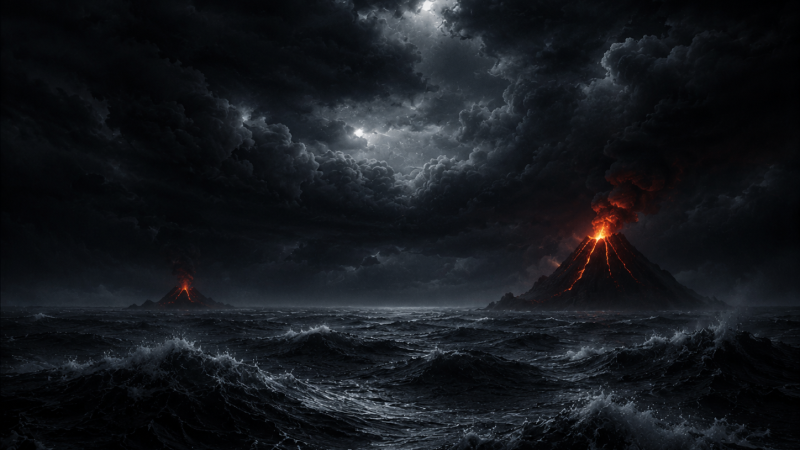
Earth Event 2
Dark Clouds Over a Watery Earth
Get Your Reminder of the Harmony from the Big Bible Store!
Just click on the image and you will be directed to the Big Bible Store for more information.

Scientific Description of the Event
One of the most consequential events after the initial formation of the Earth was the giant collision with a Mars-sized object that scientists have named Theia. This massive object slammed into the early Earth with incredible force. The impact melted large parts of both the Earth and Theia and blasted huge amounts of rocks and dust into space. Some of these rocks and dust eventually came together and formed the Moon. The collision also reshaped Earth and added even more heat to an already molten planet. After this event, Earth was a glowing, fiery world with rivers and seas of magma.
As the planet remained hot and mostly molten, its materials began to separate based on weight. Heavy elements such as iron and nickel sank toward the center of the planet, forming Earth’s core. Lighter materials rose toward the surface and helped form the mantle and the early crust of the Earth. It happened because melted materials can move more freely than solid rock. Over time, this layering created the basic internal structure that Earth still has today, which is a dense metal core in the center, surrounded by a thick mantle, and eventually a thin crust on the outside.
While the surface of the Earth was still extremely hot, volcanoes were erupting almost everywhere. These volcanoes released large amounts of gases that had been trapped inside the planet. The gases included water vapor in the form of steam as well as carbon dioxide, nitrogen, sulfur compounds, and other gases. At this stage, Earth did not have oxygen in its atmosphere like we do today. The air was thick, heavy, and very different from our modern air.
Eventually, Earth cooled enough so that the water vapor in the atmosphere could begin to condense and form tiny droplets high in the sky. These droplets joined together to form thick clouds. Because the atmosphere was packed with water vapor and volcanic gases, the clouds would have been extremely dense and dark. It would have been difficult for sunlight to shine through these dark, dense clouds. Over time, the surface temperature dropped below the boiling point of water. That meant rain could finally remain as liquid water instead of instantly turning back into steam. The rainwater would have collected in low areas of the crust and then began forming the first oceans. These oceans would have grown larger and deeper. Some scientists also think that icy comets and water-rich asteroids may have struck the Earth and added extra water. Whether most of the water came from inside the planet or from space or a mix of both, the result was the same. Earth became a watery world. Large portions of its surface were now covered by liquid water.
Even though oceans had formed, the atmosphere would have remained thick with carbon dioxide, nitrogen, steam, and volcanic gases. Lightning likely flashed through the stormy skies. Frequent volcanic eruptions added ash and particles to the air. The heavy cloud cover would have made the planet appear dark and stormy from space. The Sun’s light was dimmed by the thick layers of clouds and haze. Instead of bright blue skies, early Earth likely had a gloomy, gray appearance. At this stage, Earth had become a watery planet wrapped in heavy clouds.
Scientific Evidence for this Event
For this event, we need to examine two aspects of the early Earth. The first aspect is the water covering the early Earth. The second aspect is the darkness on the surface of the early Earth.
For the water covering the early Earth, we have evidence from the following sources.
- Zircon crystals from Jack Hills in Australia show that there was stable water, not just steam, at 4.4 billion years ago. The evidence would also suggest that there were significant and possibly widespread bodies of water at that time.
How the Event Description Harmonizes with Genesis 1
Yada Yada Yada Yada Yada Yada Yada Yada Yada Yada Yada Yada Yada Yada Yada Yada Yada Yada Yada Yada Yada Yada Yada Yada Yada Yada Yada Yada Yada Yada Yada Yada Yada Yada Yada Yada Yada Yada Yada Yada Yada Yada Yada Yada Yada Yada Yada Yada Yada Yada Yada Yada Yada Yada Yada Yada Yada Yada Yada Yada Yada Yada Yada Yada Yada Yada Yada Yada Yada Yada Yada Yada Yada Yada Yada Yada Yada Yada Yada Yada Yada Yada Yada Yada