And God said, “Let there be lights in the vault of the sky to separate the day from the night, and let them serve as signs to mark sacred times, and days and years, and let them be lights in the vault of the sky to give light on the earth.” And it was so. God made two great lights — the greater light to govern the day and the lesser light to govern the night. He also made the stars. God set them in the vault of the sky to give light on the earth, to govern the day and the night, and to separate light from darkness.
Point of View:
First Person
Day:
Day 4
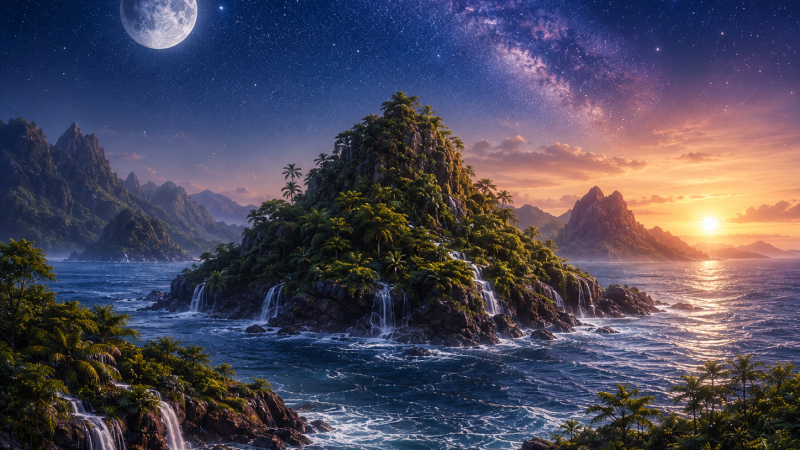
Earth Event 7
Full Visibility of Sun, Moon, Stars
Get Your Reminder of the Harmony from the Big Bible Store!
Just click on the image and you will be directed to the Big Bible Store for more information.
Scientific Description of the Event
For Earth Event 7, we will explore the development of the Earth’s atmosphere and its transparency. The reason for this is based on the assumptions that we covered in Chapter 10 of Part 2. We assumed in Chapter 10 that most of Genesis 1 is written from the perspective of an observer on the surface of the Earth. We will cover more details about that assumption at the end of this chapter. But this assumption leads to Earth Event 7 as being the time that the Sun, Moon, and Stars became clearly visible to an observer on the Earth. This was when the atmosphere and cloud cover above the Earth would be clear enough to view a sky that is similar to what we enjoy today.
For this part of our exploration, we will first travel back to when Earth first formed about 4.5 billion years ago. As we have previously discussed, the Earth’s atmosphere was very different from the one we breathe today. There was almost no free oxygen in the air. Instead, the early atmosphere was made mostly of nitrogen, carbon dioxide, water vapor, and gases released by volcanoes such as hydrogen, carbon monoxide, and methane. Scientists think that during this time, especially between about 4.0 and 2.7 billion years ago, the amount of oxygen in the atmosphere was less than one hundred-thousandth of today’s level (less than 0.001% of the modern amount). In other words, humans would not have been able to survive breathing the air at that time.
Because oxygen was nearly absent, there was also no ozone layer. Ozone is made from oxygen high in the atmosphere and acts like a sunscreen for the planet by blocking most harmful ultraviolet radiation from the Sun. Without ozone, strong ultraviolet light would have reached Earth’s surface. At the same time, the methane gas that was produced by volcanoes and by early microbes was likely building up in the air. Sunlight interacting with methane probably created a thick, smog-like haze in the upper atmosphere. Scientists compare this haze to what we see today on Saturn’s moon Titan. This haze would have scattered and absorbed sunlight, especially blue light, giving the sky a hazy orange or brown color rather than bright blue. The atmosphere may have been partly transparent in visible light, but sunlight would have been more dim and diffuse, like shining through thin smoke. So even though there were no thick clouds covering the entire planet all the time, the air itself was likely much less clear than today.
Things began to change more than 3 billion years ago when tiny ocean-dwelling organisms called cyanobacteria evolved. These microbes used sunlight to perform photosynthesis, which is a process that produces oxygen as a byproduct. At first, the oxygen the microbes released did not build up in the atmosphere. Instead, the oxygen reacted immediately with other substances. Large amounts of dissolved iron in the oceans combined with the oxygen to form iron oxides, which settled to the seafloor. These reactions created layered rocks called banded iron formations, which geologists still study today as evidence of early oxygen production. For hundreds of millions of years, oxygen was being made but also being used up just as quickly. During this long period, atmospheric oxygen probably remained below about 0.0001 to 0.001 times the modern level. The haze from methane likely continued, keeping the atmosphere somewhat murky and limiting how clearly sunlight reached the ground.
Around 2.4 billion years ago, Earth reached a turning point known as the Great Oxygenation Event. By this time, many of the materials that had been soaking up oxygen, such as dissolved iron and certain volcanic gases, were becoming used up. Oxygen produced by cyanobacteria could finally begin to accumulate in the atmosphere. The amount of oxygen after this event was still small compared to today, perhaps around 0.1% to 1% of modern levels. But it was a huge change for the planet. One important result was that oxygen reacted with methane, greatly reducing the amount of methane in the atmosphere. As methane levels dropped, the thick organic haze likely thinned or disappeared. This would have made the sky clearer and allowed more blue light to scatter in the air, gradually giving the sky more of the blue appearance that we are familiar with today.
At the same time, even small amounts of oxygen in the upper atmosphere allowed ozone to form. Ozone absorbs most harmful ultraviolet radiation. Although the early ozone layer after the Great Oxygenation Event was probably much thinner than today’s, it still reduced the amount of ultraviolet light reaching the surface. This meant the atmosphere became both clearer in visible light and safer for living things. Sunlight would have appeared brighter and less filtered by haze. However, oxygen levels were still far too low to support large animals, and most life remained simple and microscopic.
For the next billion years, from about 1.8 billion to 800 million years ago, oxygen levels appear to have stayed relatively low and stable. Scientists sometimes call this long stretch of time the “Boring Billion” because there were fewer dramatic changes in climate and life compared to earlier and later periods. Oxygen may have hovered between about 1% and 5% of modern levels. Even though that sounds small, it was enough to keep methane low and maintain an ozone layer.
Around 800 to 600 million years ago, oxygen levels began to rise again in what scientists call the Neoproterozoic Oxygenation Event. Several factors may have helped. Continents were breaking apart and rearranging, which increased the weathering of rocks. This process released nutrients into the oceans, helping photosynthetic organisms grow and produce more oxygen. Massive ice ages, sometimes called “Snowball Earth” events, may also have played a role by changing ocean chemistry and nutrient cycles. During this time, oxygen may have risen to perhaps 5% to 10% of modern levels, and possibly higher toward the end of the period.
As oxygen increased, the ozone layer thickened further. A stronger ozone layer meant even better protection from ultraviolet radiation. From about 485 to 444 million years ago, oxygen levels may have reached roughly 15% to 20% of modern levels. These conditions supported thriving marine ecosystems, including early fish, corals, and many kinds of invertebrates. With the rise of plant life and forests on land, oxygen levels continued to increase. By about 360 million years ago, the oxygen levels would probably have been comparable to our current oxygen levels. The Present Atmospheric Level of oxygen is known as PAL and is currently 21% by volume of the atmosphere. So, by 360 million years ago, models show that Earth had achieved the 1.0 PAL. This is what we are using as our criteria for having full visibility of the Sun, Moon, and Stars. But this criteria comes with some assumptions that are discussed in the last section of this chapter.
In summary, Earth’s atmosphere changed from a nearly oxygen-free, hazy, ultraviolet-intense environment in its earliest history to a much clearer, oxygen-rich, and protective system. Early on, thick methane haze likely made the sky orange and reduced transparency. After the Great Oxygenation Event, haze decreased and the first ozone layer formed. During the long middle period of low but steady oxygen, the atmosphere probably allowed more ultraviolet sunlight than today. Rising oxygen helped complex life expand across the oceans. And increases in plant life on land led to a full 1.0 level of PAL by about 360 million years ago.
Scientific Evidence for this Event
Yada Yada Yada Yada Yada Yada Yada Yada Yada Yada Yada Yada Yada Yada Yada Yada Yada Yada Yada Yada Yada Yada Yada Yada Yada Yada Yada Yada Yada Yada Yada Yada Yada Yada Yada Yada Yada Yada Yada Yada Yada Yada Yada Yada Yada Yada Yada Yada Yada Yada Yada Yada Yada Yada Yada Yada Yada Yada Yada Yada Yada Yada Yada Yada Yada Yada Yada Yada Yada Yada Yada Yada Yada Yada Yada Yada Yada Yada Yada Yada Yada Yada Yada Yada
How the Event Description Harmonizes with Genesis 1
As mentioned at the beginning of this chapter, this Earth Event crucially depends on assuming a certain point of view, as described in Chapter 10. The point of view is from the surface of the Earth. So, we can imagine that at this stage an observer could look up in the sky and finally see clearly the Sun, Moon, and Stars and experience the daily cycle of night and day that we are familiar with in our day and time. There is another issue that can create difficulties with this interpretation for some people. In the NIV translation that we are using, we read the following as part of the description for this event. God made two great lights – the greater light to govern the day and the lesser light to govern the night. He also made the stars. Genesis 1:16 The use of the word “made” here would suggest that the “two great lights” of the Sun and the Moon as well as the stars were just created. But we can explore the word that is translated as “made” in this passage to gain some further insight. The word “made” in Genesis 1:16 is translated from the Hebrew word asah. This word or one of its variations is used over 2600 times in the Old Testament. The following examples show some of the different ways that just the word asah has been translated in other Scriptures, with the translation of asah in bold text. By the seventh day God had finished the work he had been doing; so on the seventh day he rested from all his work. Genesis 2:2 He then brought some curds and milk and the calf that had been prepared, and set these before them. While they ate, he stood near them under a tree. Genesis 18:8 Sarah said, “God has brought me laughter, and everyone who hears about this will laugh with me. Genesis 21:6 Although most translations use the word “made” in Genesis 1:16, we can see from these examples that there are other valid translations that could be used that do not imply that the Sun and Moon and stars were actually created during Day 4. The passage could be translated with something like “had prepared” and still be accurate. There have been several Hebrew scholars throughout history that would support this viewpoint. From a scientific perspective, an additional issue should be discussed. Many of the scientific models that have been created for the Earth would suggest that a clear atmosphere would not necessarily coincide with an atmospheric level that is equivalent to the PAL of 1.0. The current scientific models would suggest that a lower level of oxygen could still have a clear atmosphere. These models would suggest that a clear atmosphere may have occurred up 100 million years earlier or more than the date span that we are using. If that were the case, then this Earth Event 7 would overlap or precede Earth Event 6 for plant life appearing. As has been covered in the background for Earth Events 2 and 3, however, there is no direct evidence of atmospheric conditions from millions or billions of years ago. The atmospheric conditions are always based on modeling that use other relevant environmental evidence. Since in this case, we are assuming full transparency of the atmosphere, there may be factors that are important but have not been measured yet. And it is a well-known fact that computer models are sensitive to their inputs. For our purposes, we have set the criteria of a PAL of 1.0 as a level of oxygen that we can be very confident of for a clear atmosphere. That is the oxygen level that we currently have in our atmosphere. And we know that we can see through the atmosphere clearly and so that is a safe criteria to use. So, for our timeline, we have determined the timeframe to be about 360 to 340 million years ago. So, how should be rate this Earth Event 7 in its harmony with science? We should note that the event itself is consistent with the science. Science fully supports that the atmosphere changed from having diffuse sunlight going through a dark atmosphere to a fully clear atmosphere later in Earth’s history. The only difference with Genesis 1 is the timeframe in which this change happened. By using the criterion of a PAL of 1.0, the timeframe for Genesis 1 becomes correct according to current science. But current science does not see that criterion as the most appropriate one. So, for this Earth Event of the Sun, Moon, and stars becoming fully visible, it would seem most appropriate to give the rating of Timing Not Consistent with Modeling. In the future, hopefully we will get more data which will help us be even more confident of the most appropriate criteria for a clear atmosphere millions of years ago.