

And God said, “Let the water teem with living creatures, and let birds fly above the earth across the vault of the sky.” So God created the great creatures of the sea and every living thing with which the water teems and that moves about in it, according to their kinds, and every winged bird according to its kind.
Point of View:
First Person
Day:
Day 5
Earth Event 8
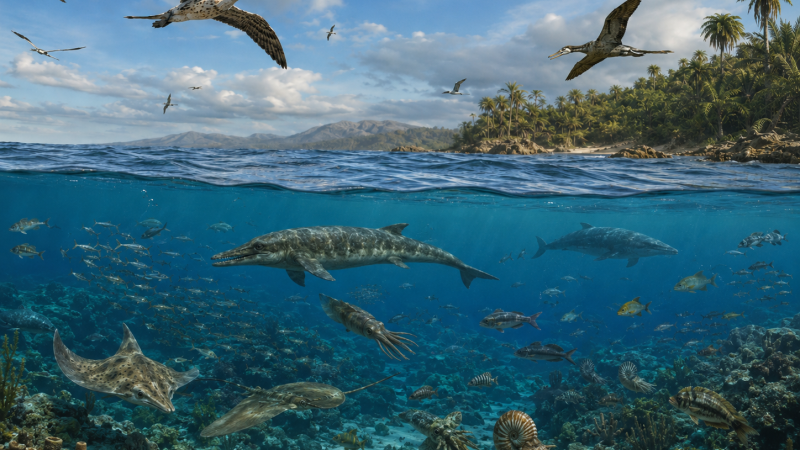
Sea Animals and Birds Appear
Get Your Reminder of the Harmony from the Big Bible Store!
Just click on the image and you will be directed to the Big Bible Store for more information.

Scientific Description of the Event
During this part of our journey, we will explore an extended history of sea life and birds. We will see later that the harmony with Genesis 1 probably references the later mammal sea life and birds that began about 40 million years ago. But for the sake of presenting a more complete exploration of the development of sea life and birds, we will cover the sea life and birds from about 340 million years ago up through about 40 million years ago. We will break up these explorations into a history of the sea life followed by a history of flying vertebrates that include birds.
From about 340 million years ago to 40 million years ago, life in the oceans went through many major changes. New kinds of sea creatures appeared, others disappeared, and entire ecosystems were reshaped.
Around 340 million years ago, during the late Paleozoic Era, the oceans were already full of life. There were many kinds of fish, including early sharks and armored fish. Coral reefs were common, but they were not exactly like the reefs we see today. Crinoids, which look like underwater flowers, covered large areas of the seafloor. Shellfish like brachiopods and ammonoids (which are relatives of the squid) were also very common.
As time moved forward toward 300 million years ago, some sea life began to change as the climate shifted. Large ice ages affected sea levels, causing shallow seas to shrink and grow. This made life harder for some species, but others
adapted. Sharks became more advanced, and new types of fish appeared.
Then came one of the most important events in Earth’s history about 252 million years ago. That was the end-Permian mass extinction. This was the largest extinction event ever known. Scientists believe it was caused by massive volcanic activity, which led to global warming, low oxygen levels in the oceans, and possibly toxic waters. About 90% of marine species disappeared. Coral reefs collapsed, and many kinds of shellfish and fish vanished.
After this great loss, the oceans slowly began to recover during the early Mesozoic Era, from about 252 to 201 million years ago. At first, the seas were fairly simple, with fewer kinds of organisms. But over time, new groups began to appear. Modern types of corals began to form reefs again. Mollusks like clams and snails became more common. The large mollusks called ammonites appeared once again and spread widely. New predators also appeared, including marine reptiles like ichthyosaurs, which looked like dolphins, and plesiosaurs, which had long necks and flippers.
During the middle of the Mesozoic Era, from about 201 to 145 million years ago, ocean life became more complex again. Coral reefs expanded, and many species of fish thrived. While dinosaurs ruled the land, the marine reptiles were at their peak. The Ichthyosaurs measured anywhere from 6 feet up to 82 feet. Plesiosaurs typically ranged from 5 to 50 feet in length. These large creatures ruled the seas, while large predatory fish hunted smaller animals. The tiny drifting organisms called plankton also became more important. These small creatures formed the base of the ocean food web and helped support larger animals.
In the latter Mesozoic Era, from about 145 to 66 million years ago, the oceans were warm and full of life. Giant marine reptiles like mosasaurs appeared and became top predators. Sharks also continued to diversify. Many modern groups of plankton, such as certain algae, became common and helped shape the chemistry of the oceans. These tiny organisms also played a key role in forming chalk and limestone deposits that we can still find today.
At the end of the Mesozoic Era, about 66 million years ago, another major extinction occurred. This event is often linked to a large asteroid impact that killed all dinosaur life except the flying dinosaurs. Many marine species also disappeared. This included the large marine reptiles like mosasaurs and plesiosaurs, as well as ammonites, which
had been common for millions of years. The oceans were once again changed dramatically.
From about 66 million years ago to 40 million years ago, ocean life entered a time of rebuilding and new beginnings. Right after the extinction event at 66 million years ago, the oceans were quieter and less crowded. Many ecological roles, such as top predators or reef builders, were suddenly empty. This gave surviving groups a chance to expand and develop into new forms.
Small organisms played an important role in this recovery. Tiny plankton, especially microscopic algae and single-celled organisms, quickly spread through the oceans again. These organisms formed the base of the food chain. As they grew in number, they helped support larger animals like fish and squid.
Fish that survived the extinction began to diversify. Many of these were early versions of modern fish groups, including bony fish. Sharks also survived and began to grow in number again, taking advantage of the lack of large marine reptile predators.
As millions of years passed, ocean ecosystems became more complex. Coral reefs began to recover and expand. These reefs were built by corals similar to those we see today, along with algae and other organisms that helped hold the reef structure together.
One of the most important developments during this time was the rise of modern marine groups. Crabs, lobsters, clams, and snails became more common and diverse. These animals lived on or near the seafloor and played important roles in the ecosystem by feeding on plants, plankton, or other animals.
Different fish types continued to develop rapidly. Many modern types of fish, including those with thin, flexible fins and fast swimming abilities, became more widespread. These fish could move quickly through the water, helping them escape predators or catch prey.
Sharks also became more advanced. Some early relatives of modern sharks began to appear, with improved teeth and stronger bodies. They filled the role of top predators in many ocean environments.
One of the most fascinating changes during this time was the development of whales. Unlike most sea creatures, whales did not start in the ocean. Their ancestors were land mammals that lived near rivers and coastlines. Around 50 million years ago, some of these land mammals began spending more time in the water. Early forms like Pakicetus still had legs and could walk on land, but they likely hunted in shallow water. Later forms, such as Ambulocetus, were better adapted for swimming and may have moved between land and water like modern seals.
Over time, these predecessors to whales became fully aquatic. Their bodies became longer and more streamlined, their legs turned into flippers, and their tails became powerful tools for swimming. By around 40 million years ago, early whales like Basilosaurus lived entirely in the ocean and could grow quite large.
During this period, the Earth was generally warmer than it is today. Warm oceans supported a wide variety of life, especially in shallow seas. However, there were also gradual changes in climate and ocean circulation.
The movement of continents slowly changed ocean currents. This affected how nutrients were spread through the water. In some areas, nutrient-rich waters allowed plankton to thrive, which in turn supported large populations of fish and other animals.
Tiny organisms continued to play a huge role. When plankton died, their shells and skeletons settled on the ocean floor, forming layers of sediment. Over time, these layers turned into rock, such as limestone and chalk. These rocks are important to scientists because they record the history of ocean life.
By 40 million years ago, many of the main groups of marine life that we recognize today were already in place. Coral reefs were well developed, fish were diverse and widespread, and marine mammals had become important parts of the ecosystem.
The oceans were no longer dominated by giant reptiles, as they had been earlier. Instead, they were filled with fish, sharks, invertebrates like crabs and clams, and the first whales. Food webs had become complex again, with many layers of predators and prey.
This time period shows how life can recover after a major crisis. In just a few tens of millions of years, the oceans went from being damaged and simplified to rich and diverse once again. The changes that happened between 66 and 40 million years ago helped shape the marine ecosystems that still exist today.
During the age of dinosaurs, different kinds of animals began to explore the sky. The first flying vertebrates were pterosaurs. They appeared about 230 million years ago. Pterosaurs were not birds and not dinosaurs, but close relatives. They had large wings made of skin stretched over a very long finger. Their bones were light, which helped them fly. They ruled the skies for millions of years.
At the same time, many dinosaurs were changing and becoming more advanced. A group called theropod dinosaurs included meat-eaters like Tyrannosaurus rex, but also many smaller, lighter animals. Over time, some of these
theropods developed feathers. At first, feathers likely helped keep them warm or helped with display, not flight. But later, feathers became useful for gliding and eventually flying.
One of the most famous early bird-like animals is Archaeopteryx. It lived about 150 million years ago and is the first creature who has been classified with the Aves class. This is where we get the word of “avian” that we use for modern birds. The Archaeopteryx had feathers and wings like a bird, but also teeth, claws, and a long bony tail like a dinosaur. Because of this mix of features, scientists see it as a bridge between dinosaurs and birds. It may have been able to glide or fly short distances.
By 130 million years ago, the birds began to spread out and become more diverse. Two important groups appeared. One group was the enantiornithines. These were the most common birds of their time. Many lived in trees and had claws on their wings and teeth in their mouths. They could fly, but not as efficiently as modern birds.
The other group was the early ornithuromorphs. These birds were closer to the birds we see today. They had shorter tails, stronger breastbones for flight muscles, and better flying ability. Some lived near water and were good swimmers or fish catchers. Over time, this group became more successful.
At the extinction event of 66 million years ago, the pterosaurs and the enantiornithines were wiped out. However, some ornithuromorph birds survived.
In the first few million years after the extinction event, the surviving birds were mostly small and lived simple lives. Many likely ate seeds, insects, or small animals. Some lived near water and caught fish. The world was still recovering, and forests had been damaged, so birds had to adapt to changing environments. During this time, birds began to slowly spread out and fill empty roles in nature.
By about 56 million years ago, the Earth became warmer and forests grew again across much of the planet. This created many new habitats for birds. The ornithuromorphs began to change and diversify much more quickly. They developed stronger flight abilities, better wings, and lighter skeletons. Their tails became shorter, and their bodies became more like the birds we see today.
Different types of birds began to appear. Some became good swimmers and lived in lakes and oceans. Others lived in trees and developed the ability to perch on branches. Some became hunters, while
others ate plants, seeds, or insects. By around 50 million years ago, many early versions of modern bird groups had already formed, including birds similar to ducks, shorebirds, and early perching birds.
Fossils from places like the Green River Formation in North America and sites in Europe show that birds during this time were already very diverse. Many of them looked surprisingly modern, even though they lived millions of years ago.
By about 40 million years ago, ornithuromorph birds had spread across the world and taken over many ecological roles. They had become the dominant flying animals on Earth. The basic groups of birds that exist today were beginning to take shape, setting the stage for the wide variety of birds we see in the present day.
Scientific Evidence for this Event
Yada Yada Yada Yada Yada Yada Yada Yada Yada Yada Yada Yada Yada Yada Yada Yada Yada Yada Yada Yada Yada Yada Yada Yada Yada Yada Yada Yada Yada Yada Yada Yada Yada Yada Yada Yada Yada Yada Yada Yada Yada Yada Yada Yada Yada Yada Yada Yada Yada Yada Yada Yada Yada Yada Yada Yada Yada Yada Yada Yada Yada Yada Yada Yada Yada Yada Yada Yada Yada Yada Yada Yada Yada Yada Yada Yada Yada Yada Yada Yada Yada Yada Yada Yada
How the Event Description Harmonizes with Genesis 1
In the context of the 4.5 billion year history of the Earth, the time period of 340 to 40 million years ago is relatively recent. This leads to an abundance of evidence from fossils of sea life and birds. The fossil evidence can also be dated with relative precision using radiometric dating and the dating of the geological layers where the fossils were found.
The description from Genesis 1:20-21 is also very clear and it references some variation of the sea life and bird life that we as humans have witnessed ourselves. Since there has been sea and bird life for hundreds of millions of years, then the question arises as to what time frame from science we should use for comparing the events with Genesis 1:20-21. In this context, it would seem prudent to see if the words used for these sea creatures or birds are used in other passages in the Old Testament. In Genesis 1:21 the Hebrew word for “creatures of the sea” is tannin. There are 26 other occurrences of this word in the Old Testament. An example is shown below.
Am I the sea, or the monster of the deep,
that you put me under guard?
Job 7:12
The fact that this creature is mentioned by Job and other writers in the Bible would limit this sea creature to an animal that would have present during the time that mankind has been alive. This is the reason that this date has been extended to a period of 40 million years ago. By this time, the whales, sharks, and other candidates for a “monster of the deep” would have appeared and not gone extinct.
Furthermore, the Hebrew word for “living creatures” in verse 20 is ne·p̄eš. This is also the root word for the soul of a human being, so these living creatures are usually considered to be “soulish
creatures”. This would probably best fit the whales since modern science is finding that their communication skills are fairly sophisticated.
With that understanding, it seems safe to say that the harmony between the Earth Event 8 of sea animals and birds appearing is Very Consistent with the scientific evidence.